





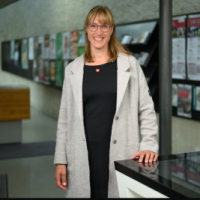
Hannah Crepaz: Culture in Hall is female
Interview with Hannah Crepaz, Director of the Galerie St. Barbara
I had the pleasure of meeting one of the best-known – and, to me, most remarkable – women on the Tyrolean cultural scene. Hannah Crepaz is the artistic director of the Osterfestival Tirol and has been at the helm of the cultural institution Galerie St. Barbara in Hall in Tirol for over a decade.

Hannah, you grew up surrounded by your parents’ cultural work. How did that shape you?
She laughs. “I grew up immersed in culture. In 1968, a group of young people in Hall founded the Galerie St. Barbara and invited my parents, Maria and Gerhard Crepaz, to organise the musical programme. Art and music were my second home. I was also allowed to accompany my parents on their travels.” My father’s motto was: “A day lost at school is a day gained for life.”
Today, she is herself the mother of a daughter who scurries quite naturally through the offices of Galerie St. Barbara. But times have changed, Hannah believes. For women in particular, the balancing act between work and family is not easy to manage. Like many others, she, too, feels the constant pressure from society. That is why she supports the call for a fair division of responsibilities. Men, too, should rethink their traditional role. Politicians need to take action here, for example by introducing a statutory division of parental leave between men and women, similar to the Swedish model.
The Tyrol Easter Festival has been running for over 32 years. You took over as artistic director in 2009.
When it first began – in 1989 – the Tyrol Easter Festival was called “Music of the Religions”. Each year, the focus was on a different cultural group and the religions associated with it. Hannah sees herself as a mediator. Through her work, she aims to introduce us to the unfamiliar and bridge the gap between distant cultures, in order to encourage a change in mindset.

The only multidisciplinary festival in western Austria, which this year has the theme ‘Peace?’, offers a powerful expression of this. Due to the coronavirus, it had to be cancelled at Easter and will be partially rescheduled as an October festival. Austrian artists explore the theme of the desire for peace. The programme is extensive: early and contemporary music, dance and readings. Usually, the Tyrol Easter Festival, with its 40 venues and other special formats, takes place in venues where people rarely come into contact with the arts or live on the margins of society.
What does your work mean to you? What is the state of the cultural scene? What is the gender balance like?
The arts and culture scene is very small and close-knit. You keep bumping into the same people and there’s usually a lively exchange of ideas, which is lovely. In leading positions, the arts and culture sector is often male-dominated. It’s lovely to see that the Vienna Volksoper has appointed a woman to its helm. But of course, women play an important role in this scene. Hannah affectionately calls them ‘the busy bees’. When this topic comes up, you notice that she, who is otherwise so composed, becomes more emotional. Hannah certainly receives the respect she undoubtedly deserves from her male colleagues. Her work leaves little room for criticism, as she promotes not only high-profile figures but, above all, local and young artists. Envy and resentment lead to a pointless drain on energy, particularly in the arts and culture scene; the Haller native is convinced of this.
Hannah’s work and that of the gallery are renowned far beyond the region’s borders, with the result that artists approach her of their own accord. Nevertheless, she travels extensively and enjoys travelling throughout Europe to see composers, musicians and dancers perform live, with a view to bringing them to Tyrol.
You’re a very creative person. What inspires you? Where do your ideas come from?
Hannah is a member of various cultural committees. Her working day does not end at 5 pm when she leaves her desk at the Galerie St. Barbara. Quite the opposite: her work is always on her mind and she approaches everything with passion. This inner motivation gives rise to brilliant ideas. But in truth, it is the artists and the music that inspire her most of all.
You live and work in Hall. What does this town mean to you?
The town of Hall, with its high quality of life, is a true place of power for her. She finds the enchanting courtyards very calming, whilst the small, winding alleyways inspire her to daydream. These small, special places give her a great deal of strength and energy. But the surrounding countryside also inspires the artist. She loves being active in the fresh air. Hannah Crepaz really appreciates the fact that it only takes a few minutes to reach Absam or Gnadenwald, where she can really let off steam.
Like mother, like daughter. Both enjoy returning to their home town after extended trips around Europe. “The most important thing for a successful mother-daughter relationship is the bond with your own child,” says Hannah. She attaches great importance to making time to spend with her daughter – without any distractions. Even if it gets late in the evening, Hannah makes a point of baking or doing a craft project with Alice.
I would like to thank you for the stimulating conversation, and I hope that all of us who are moved by culture – in whatever form – will soon return to a healthy new normal.
The Oktoberfestival takes place from 20 October to 30 November 2020. The musik+ 2020/21 programme begins on 27 October with a concert by ‘Jordi Savall and Friends’ entitled ‘Refuge in Memory’ at the Haller Salzlager. Further information is available at: https://www.musikplus.at/